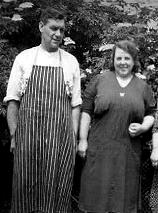
Iris Sylvia Canning was born on the 28th October 1929 in India. Iris had two sisters, Ruby and Violet (Taj). Iris grew up and her family moved to England. Iris’s father died in South Africa, while Iris was still young, her mother then became too ill to look after her, and Iris and her sisters went to live with cousins, Mr & Mrs Green.
Carte de visite photograph of Florence Nightingale, by Kilburn, circa 1854. (Photo credit: Wikipedia)
Iris left school and became an auxiliary nurse, she was a very lively girl, full of laughter. In January 1950 Iris had a son and called him William. Read more…
Nursing in the United Kingdom has a long history, but in its current form it probably dates back to the era of Florence Nightingale, who was instrumental in helping to lay the foundations of professional nursing in 1860. Her nursing school at St Thomas’ Hospital in London, the first secular nursing school in the world (now part of King’s College London). The Nightingale Pledge taken by new nurses was named in her honour, and the annual International Nurses Day is celebrated around the world on her birthday.
As time progressed Iris met a man called Archie Brown, they fell in love and got married. Iris then had 9 more children, they were called Steven, Philip, Rosemary, Julia, Andrew, Angela, Douglas, Christopher and Margaret. Read more…
She had a good innings but still she deserved to live a lot longer, a very happy and kind lady who lived through two wars. She married Stanley W. Rogers and had three children by him the first being Terry, followed by Monica and last the only one now left my aunt Marcia. She brought them all up with family values, and during the Second World War she and the children were evacuated to Bude in Cornwall, now at the time of this she was living in Eltham, London, so travelling to and from Bude became a regular occurrence. She worked at the Woolwich Arsenal in between and after the war until retirement. After the war had ended, the family moved to Welling and then on to Plumstead, both in southeast London. Read more…
Staff from the Royal Arsenal helped design, and in some cases managed the construction of, many of the new second World War Royal Ordnance Factories (ROFs) and ROF Filling Factories around the UK. The majority of the ordnance production was moved from the Royal Arsenal to new sites as the Royal Arsenal was considered vulnerable to aerial bombing from mainland Europe. The original plan was to replace the Royal Arsenal’s Filling Factory with one at ROF Chorley and one at ROF Bridgend. It was then realised that many more ROFs would be needed. Just over 40 ROFs were opened by the end of World War II, nearly half of them Filling Factories. 30,000 people worked at the Royal Arsenal during World War II.
The Royal Arsenal was caught up in The Blitz; the staff of the Chemical Inspectorate, working with explosives, were evacuated in early September 1940. Shortly afterwards one of the Frog Island buildings was destroyed by bombing and another damaged. The laboratories were partially re-occupied in 1945 and fully re-occupied by 1949.
During the quiet period after the end of World War II, the Royal Arsenal built railway wagons for export. Armament production then increased during the Korean War.
Sam Bright, was what you would call a real character. He couldn’t wait for the moment to tell a story or crack a joke. A soldier, a coal miner, a chef at Blackpool Casino, a fish and chip shop owner, a shopkeeper, a pallbearer, these were a few of his careers.
During the First World War he found himself as a cook, responsible for the well being of his comrades. The meager rations that the army supplied needed supplementing by scavenging. Often he went on ‘raiding parties’, sneaking into French farms, pilfering this and that. He once found himself in a Frenchman’s dovecote. This was nearly his final mission. The farmer gave chase and then leveled his loaded rifle at him. He wasn’t really proud of his thieving but as he explained, it was war and his mates were hungry. One of his most poignant tales was about a march to the ‘front’. In the hedgerow Sam spotted a ham bone which had a bit of meat left on it. They got to the frontline and as the history books tell us conditions were appalling and the rations were low. Sam remembered the ham bone, and on the march back retrieved it from the hedge to use in the next stew.
British stretcher bearers recovering a wounded soldier from a captured German trench during the Battle of Thiepval Ridge, late September 1916, part of the Battle of the Somme. (Photo credit: Wikipedia)
The Battle of the Somme between 1 July and 18 November 1916 took place on either side of the river Somme in France – this was where Sam was wounded and lost an eye. He spotted a German sniper who unfortunately spotted him first. He was wounded and his commanding officer suggested that he remained at his post to give his comrades a better chance to fallback, promising his family a medal for his sacrifice. I’m not sure what he said but he was invalided out of service and was treated at Guys Hospital in London, where they patched him up and cosmetically made a fine job. Apparently this damaged eye was assisted by a rabbit’s nerve.(?)
This bloody battle saw the British Army, supported by contingents from British imperial territories, including Australia, New Zealand, Newfoundland, Canada, India and South Africa, mount a joint offensive with the French Army against the German Army, which had occupied large areas of France since its invasion of the country in August 1914. The Battle of the Somme was one of the largest battles of the war; by the time fighting paused in late autumn 1916, the forces involved had suffered more than 1Â million casualties, making it one of the bloodiest military operations ever recorded. Read more…